
Feathers, Flight, and a Singular Vision: The Artistry of Chris Maynard

Updated: Jul 6
Feathered Masterpieces: The Artistry of Chris Maynard | North Gallery | June 11 – September 14, 2026

There is a moment, standing in front of Chris Maynard's work, when you realize you are not looking at a painting or a photograph or a sculpture in any conventional sense. You are looking at a feather — a single shed feather, or two, or three — that has been transformed by a scalpel, a pair of surgical scissors, and a lifetime of patient attention into something quietly astonishing.
Birds emerge from the feather itself, carved through its surface with breathtaking precision: shorebirds walking along a wave-cut shore, flocks lifting off and scattering across open white space, silhouettes of flight suspended in the iridescent blue-green of a jay's wing feather. The cutouts are elevated slightly from their backgrounds so that each feather casts its own shifting shadow.
This is the art of Chris Maynard — and it is on view now at SJIMA.
A Life Shaped by Birds
Maynard grew up in Washington State, retreating as a boy to the woods near his home, lying in the moss beneath towering fir and cedar trees, watching birds move through the canopy above him. At age twelve, he received a single exotic feather — and something clicked into place that has never let go.
His path to becoming a full-time artist was not a straight line. Maynard trained as a biologist with a focus on entomology, then spent years working as a hydrologist for the Washington State Department of Ecology, negotiating improved water flows for salmon below hydroelectric dams. He understood the natural world not just aesthetically but scientifically — its systems, its pressures, its fragility. That knowledge never left him. In 2008, he made the decision to devote himself entirely to his art, driven by what he describes as a core mission: to foster appreciation and understanding of the natural world.

His family shaped him in ways that are still visible in his studio today. His mother was a professional visual artist who taught classes in her home and had notebooks filled with bird sketches — birds she'd likely spotted outside the window. After she passed, Maynard found those notebooks — and has made pieces directly inspired by her drawings. His father was an eye surgeon — and it was his father's surgical tools that first put a scalpel and forceps in Maynard's hands. Today he works with surgery-grade tools of his own, a practice rooted in that early inheritance.
"My work with feathers gives me a satisfying perch from which to view the world." — Chris Maynard
The Art Form & the Process of Chris Maynard
What Maynard does with a feather has no real precedent. Working under magnification with surgery-grade surgical tools, he cuts feathers into intricate compositions — birds in flight, in community, in stillness — with a precision that is almost impossible to fully comprehend until you are standing close to the work itself.

Crucially, he never flattens the feathers or adds paint or pigment of any kind. The colors you see are the colors the bird grew. The shapes you see are the shapes the feather naturally holds. Maynard's role is to listen to what the feather already is — and then reveal what it can become. Each cutout is elevated from its background on tiny pins, preserving the feather's natural three-dimensional curve and allowing it to cast shadows that shift as the light changes.
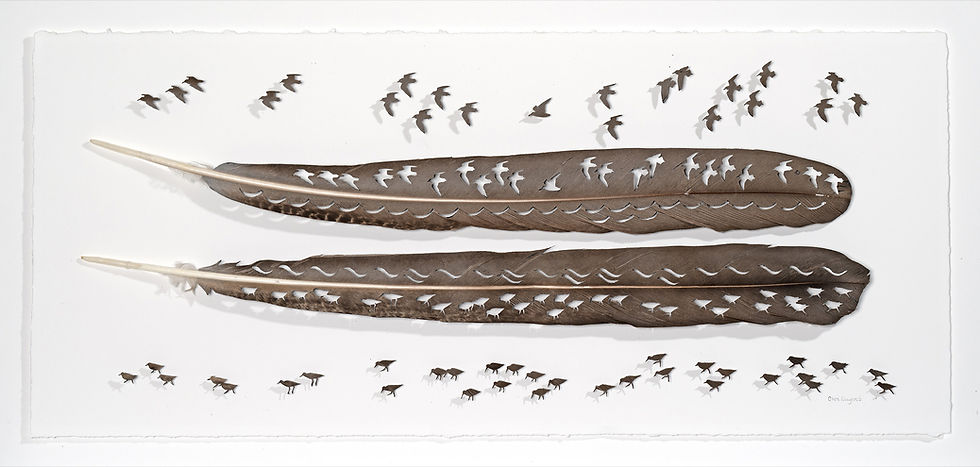
In Piercing the Veil, three iridescent blue-green feathers become a single soaring composition — birds carved through each surface, their cutout silhouettes lifting off and drifting outward across the surrounding white space, as if the flock itself is breaking free of the feather that contained it. In Waveline Shorebirds, two large brown feathers carry a double narrative: waves cut into the upper feather, shorebirds moving along the lower feather — and then more shorebirds, carved from the feather itself, walking across the composition below. The work doesn't just depict birds. It is made of them.
"I don't trim or flatten the feathers but keep their natural curves and shapes by elevating them from the background. By honoring the feathers in this way, I feel they have reciprocated by enhancing my work with their shadows. So, each piece changes according to the intensity and angle of the light that shines on it. My work highlights the patterns and colors of the feathers themselves, inviting the viewer to look and look again." — Chris Maynard
Conservation at the Core
Maynard is a conservationist as much as he is an artist. Every feather in his work is legally sourced in full compliance with the Migratory Bird Treaty Act and CITES — the international treaty governing trade in endangered species. Because most North American bird species are federally protected, he works primarily with feathers from non-native species: turkeys, parrots, peacocks, great argus pheasants, and others gathered through an extensive network of private aviaries and zoos around the world. Most feathers are naturally shed.
That last fact carries a quiet poetry that Maynard returns to often. Many of the birds whose feathers appear in his shadow boxes are still alive somewhere — still flying. The work is not about loss. It is about honoring what already exists, and making it visible in a new way.
He is a signature member of the Society of Animal Artists and a member of Artists for Conservation, and he leads bird-watching field trips with his local Audubon chapter in Olympia, Washington. The studio and the field are not separate worlds for Maynard. They are the same world, seen at different scales.
A World in a Feather
Maynard's work has reached audiences far beyond the Pacific Northwest. His pieces have been featured in National Geographic, Audubon, Fine Art Connoisseur, Western Art & Architecture, and The Smithsonian, as well as PBS's Craft in America, The Discovery Channel's Daily Planet, and the Daily Mail UK. He delivered a 2015 TEDx Talk — "A World in a Feather" — at the Washington Center for Performing Arts in Olympia. His art book, Feathers, Form and Function (Aviva Publishing, 2014), now in its fourth printing, pairs photographs of his work with essays on feather biology, evolution, and the cultural meanings humans have attached to feathers across centuries.
His collectors span North America, Asia, Europe, and Australia. And yet the work remains rooted in the same instinct that sent a boy into the Washington State woods to watch birds: the belief that if you look closely enough at the natural world, it will give you something back.

SJIMA's North Gallery — intimate in scale, designed for close looking — is exactly the right space for this work. You will want to stand near it. You will want to move, and watch the shadows shift.
Plan Your Visit — and Meet the Artist
Feathered Masterpieces: The Artistry of Chris Maynard is on view in the North Gallery through September 14, 2026. SJIMA is located at 540 Spring Street in Friday Harbor, open Thursday through Monday, 11 AM–5 PM. General admission is $10; free for members and visitors under 18. Pay-what-you-like every Monday.
And mark your calendar: on Wednesday, July 8 at 6 PM, Chris Maynard will be at SJIMA for a free artist talk — open to all, no ticket or RSVP required. This is a rare opportunity to hear directly from the artist about his process, his practice, and the work on view. Arrive a few minutes early to get a good seat.
SJIMA gratefully acknowledges the generous support that makes our Summer 2026 exhibitions possible: Honeywell Foundation, Mark Torrance Foundation, Town of Friday Harbor, San Juan County, San Juan Island Community Foundation, Barbara Von Gehr, Peg Gerlock, and Phil Johnson. In-kind support provided by Harbor Rental, Printonyx, Piece of Cake Painting, and Friday Harbor Suites.
