
A Woodshed, an Apple Box, and a Copper Plate: Meg Partridge on Curating Her Own Family
- SJIMA
- 2 days ago
- 5 min read
Updated: 1 day ago
Meg Partridge, guest curator of Convergence & Divergence: The Family Aesthetic, talks about the three artists she knew first as her grandmother, her grandfather, and her father.
Most curators come to their subject from the outside. Meg Partridge came to hers from the inside of a darkroom.
Her grandmother was Imogen Cunningham. Her grandfather was Roi Partridge. Her father was Rondal Partridge. Convergence & Divergence: The Family Aesthetic, on view in the Nichols Gallery through September 14, brings the three of them together for the first time — over 100 photographs and prints drawn from the artists' personal archives.
Sitting among the work with SJIMA Trustee and Lead Docent Marney Reynolds, Meg talked through how the exhibition came together, what she was looking for, and the small, specific stories that don't fit on a wall label. The camera cuts away to the pieces as they come up in conversation.
Thirty to forty images, and a story
The premise was simpler than the archive it came from. She and SJIMA settled on roughly thirty to forty images per artist — enough to show the variety of what each of them accomplished across a lifetime, and enough to reveal something harder to see: how the three of them interacted and overlapped creatively, culturally, and personally.
”For me, it's all about telling a story" – Meg Partridge

For the photographers — Imogen and Rondal — that meant still life, street work, personal work, portraits, self-portraits, and family. Roi's range was narrower: he was an etcher, and he stayed with the landscape. But the groupings on the walls are built to talk to each other, not just to hang near each other.
Imogen: strength and simplicity
Imogen's start was self-made. Her father set up a darkroom for her in the woodshed — sufficient, Meg noted, because the techniques of the day didn't strictly require running water. At the University of Washington there were no photography classes to take, so she went after the next best thing and took a degree in chemistry. It served her well: in those days you often made your own chemistry to make your prints.
Meg traces that independence back to Imogen's upbringing. She was raised, Meg said, in an environment of you can do anything, just do it — you have to figure it out, we're not paying for it, but you can do it. The obligations the world wanted to put on a woman didn't stop her, because she never granted them the attention.
”She dismissed it but wasn't even aggravated by it. She just went around it." – Meg Partridge
The botanicals — the work that made her famous — started as a practical solution. As Imogen put it: "I had three children in two years, and what could I do?" What she could do was be in the garden. Meg described watching her grandmother out there under the dark cloth with a white card propped behind an agave, stripping the background away to get at what she was after: strength and simplicity.
The line Meg offered as Imogen's working philosophy — as she recalled it: "The best photograph I've ever made is the one I'm going to take tomorrow."
Roi: a letter from Paris
Imogen and Roi met, as Meg put it, virtually. She was in Seattle; he was in Paris studying etching. They exchanged letters over a shared interest in an exhibition of his, fell in love, and started their life together around 1915.

Roi pursued etching with clarity his whole life. He carried his plates out into the landscape and worked en plein air, scratching images into copper — sometimes zinc — while Imogen was out on the same adventures photographing, sometimes the same subjects. He'd get the etching structured and formed outdoors, then refine it in the studio. Never a change of mind, Meg said, so much as an adjustment — a little more depth in the shadows and that kind of approach.
”It is amazing to me that it's like a magic act, to take a little scribe and make a beautiful image out of it." – Meg Partridge
Rondal: an apple box and a parking lot
Rondal was born in 1917, one of Imogen's twins. By about five he was standing on an apple box to reach the darkroom sink, helping his mother develop prints — running contact prints out into the ultraviolet daylight to expose, then carrying them back in to finish. He had the technical side down by the time he was a teenager.
So when he went to work for Dorothea Lange as her driver, ferrying her around central California while she photographed the Depression and the influx of migration into the state, the education wasn't technical. It was about how another person sees. He got a second version of that lesson working as Ansel Adams's assistant in Yosemite — hauling cameras up vertical rock behind a man Meg described as absolutely perfectionist-oriented, and shooting his own frames on the side.
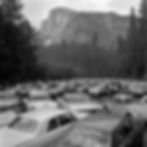
What stuck was one instruction. Dorothea said to Rondal: photograph changing California. Just that. Photograph changing California. He spent his whole life doing it — putting the pristine and the tragic into a single frame. Half Dome fills the top half of the picture, almost perfectly the top half, and the bottom half is all parking lot.
Why any of this matters in a gallery
Meg's own answer was about doors. Seeing someone pursue something relentlessly, she said, lets a visitor think I'm in that lane — or I've never looked at something as simple as an unmade bed before, and said, oh, that's kind of fun.
”It opens up doors and the opportunity to look at things differently, and that's what I love about going to a museum." – Meg Partridge
Watch the full interview
The complete conversation between Meg Partridge and Marney Reynolds is embedded above — roughly twenty-three minutes recorded in the Nichols Gallery, cutting to the individual works as they discuss them. It's worth your time before you visit, and worth revisiting after.
Save the date: an etching talk, July 22
Etching is one of the oldest print processes in Western art, and one of the least understood by the average gallery visitor. On Wednesday, July 22, 4:00–5:30 PM, Meg Partridge returns to open The Art of the Line: An Etching Talk with Meg Partridge & Howie Rosenfeld with a look at her grandfather's seven decades with the medium. Local artist and printmaker Howie Rosenfeld then walks the audience through the etching process itself, with tools and a small portable press on hand to show how a plate becomes a print. The 4 PM start is set to accommodate inter-island ferry schedules.

SJIMA gratefully acknowledges the generous support that makes our Summer 2026 exhibitions possible: Honeywell Foundation, Mark Torrance Foundation, Town of Friday Harbor, San Juan County, San Juan Island Community Foundation, Barbara Von Gehr, Peg Gerlock, and Phil Johnson. In-kind support provided by Harbor Rental, Printonyx, Piece of Cake Painting, and Friday Harbor Suites.
Convergence & Divergence: The Family Aesthetic is on view in the Nichols Gallery through September 14, 2026, at the San Juan Islands Museum of Art, 540 Spring Street, Friday Harbor. Summer hours are Thursday–Monday, 11 AM–5 PM. Admission is $10 general; free for members and visitors under 18. Pay-what-you-like every Monday.